Latest Digital Marketing Research: What Is Working in 2026?
Search visibility is no longer explained by rankings and clicks alone. Google AI Overviews, answer engines, zero-click behaviour and local discovery now influence how customers find, assess and choose a business—often before they visit its website.
Applying research-backed frameworks to regional businesses via our Local SEO Wollongong campaigns. Discover how we optimise enterprise entities for generative discovery on our AI Search Optimisation (AEO/GEO) hub.
This research hub separates confirmed evidence from industry assumptions. It brings together Creative Orbit experiments, Google Search Console findings, Australian market observations and primary research from organisations such as Google, Pew Research Centre and Ahrefs.
Why Research-Driven Strategy Matters
Search advice ages quickly. A tactic that increased organic traffic two years ago may now produce impressions without clicks, while a page with modest traffic may influence customers through AI citations, branded searches or Google Maps.
I use current evidence to decide what deserves attention, what needs testing and what can be ignored. That includes analysing Creative Orbit’s own search data rather than relying only on broad overseas benchmarks.
Research should improve the decision
- Separate evidence from opinion: distinguish confirmed platform guidance, independent studies and first-party observations.
- Measure the right outcome: look beyond rankings to citations, qualified enquiries, branded demand and local visibility.
- Prioritise limited resources: direct time and budget towards changes with a clear commercial purpose.
- Challenge stale assumptions: revisit tactics when search behaviour, interfaces or measurement methods change.
- Apply Australian context: interpret global research for Wollongong, the Illawarra and regional service businesses.
The aim is not to chase every new search acronym. It is to understand what changed, test whether it matters, and turn reliable findings into a practical SEO and digital growth strategy.
Key 2026 Research Findings
Evidence currently reshaping SEO and AI search strategy
21,919 AI-Related Impressions
Creative Orbit recorded 21,919 impressions across more than 500 AI-related queries over 90 days, but only 41 clicks. The 0.187% click-through rate shows why AI-category impressions increasingly need to be interpreted as visibility and brand exposure—not traffic alone.1
58% Lower Position-One CTR
Ahrefs found that an AI overview correlated with a 58% lower average click-through rate for the top-ranking page as of December 2025. A strong organic position can therefore remain valuable while delivering substantially fewer visits than historical SEO models predict.2
8% Click When an AI Summary Appears
Pew Research Centre found that users clicked a traditional result in 8% of visits containing a Google AI summary, compared with 15% when no summary appeared. Only 1% of visits produced a click on a source inside the AI summary.3
LCP, INP and CLS
Core Web Vitals now centre on loading speed, responsiveness and visual stability. INP replaced FID in March 2024, so current performance work should evaluate LCP, INP and CLS using real-user field data rather than relying on an outdated FID report.4
E-E-A-T Is Not a Single Score
Google says E-E-A-T is not one specific ranking factor. Its systems use a mix of signals that can identify experience, expertise, authoritativeness and trustworthiness, while quality-rater feedback helps Google evaluate its systems rather than directly rank individual pages.5
No Special AI Markup Required
Google says AI Overviews and AI Mode require no special schema, AI text file or separate optimisation framework. Pages still need standard crawlability, indexability, useful content, internal links, good page experience and structured data that matches visible text.6
What This Research Covers
The collection focuses on the points where search technology, customer behaviour and commercial outcomes meet.
SEO and Local Search
Google rankings, Map Pack visibility, Google Business Profile optimisation, technical SEO and location-specific opportunities for Wollongong and Illawarra businesses.
AI Search Visibility
AI Overviews, ChatGPT, Perplexity, citations, brand mentions, answer-engine visibility and the measurement challenges created by zero-click discovery.
Content and Authority
First-hand experience, original research, authorship, entity clarity, structured content and the evidence that helps people and machines assess credibility.
Web Performance and Conversion
Core Web Vitals, accessibility, technical delivery, analytics and the path from search visibility to a qualified enquiry, booking or sale.
Start with the evidence most relevant to your current problem. The latest studies, experiments and field observations are listed below, with each article linking its claims to named sources and practical next steps.
Latest Research
AI SEO Paradox
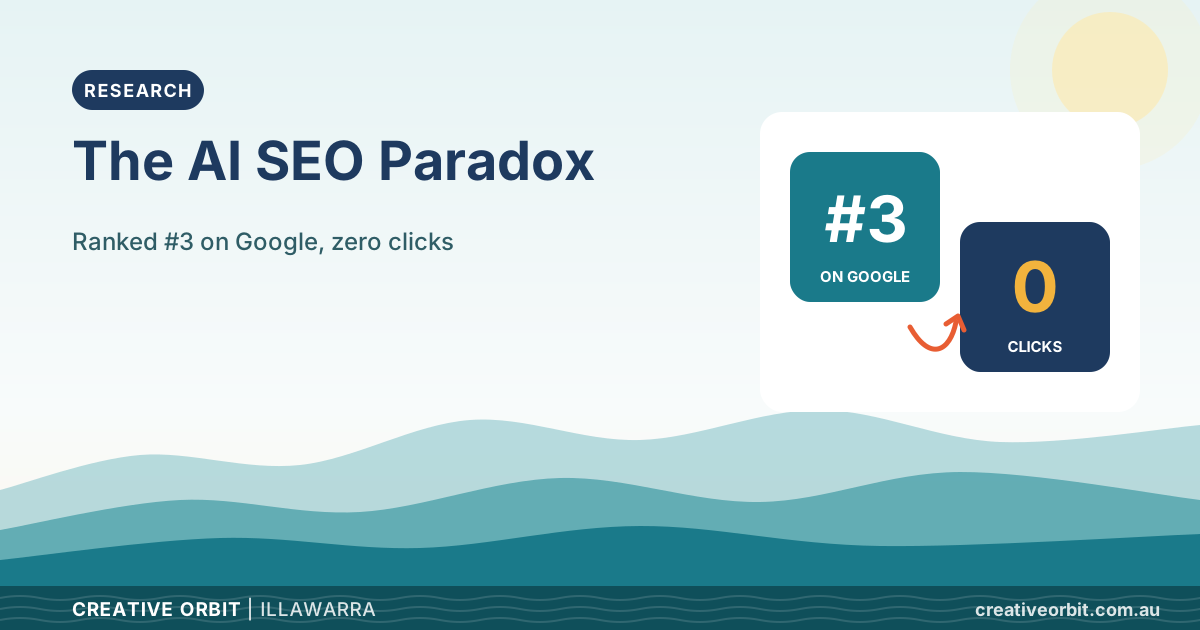
Here’s a number that stopped me mid-coffee: for “AI SEO Audit Sydney", Creative Orbit sits at...
Business Visibility & AI Search
AI search visibility cannot be proven by asking one chatbot once. Wollongong businesses need...
Google AI-Generated Website Limits
Google has no percentage limit for AI-generated content. In 2026, rankings are determined by...
Human Content vs AI
Human-written content does not automatically outrank AI-generated content. Google evaluates...
Measure AI Search Visibility
An AI visibility scorecard records, for a fixed set of customer questions, whether AI tools...
Schema for AI Search
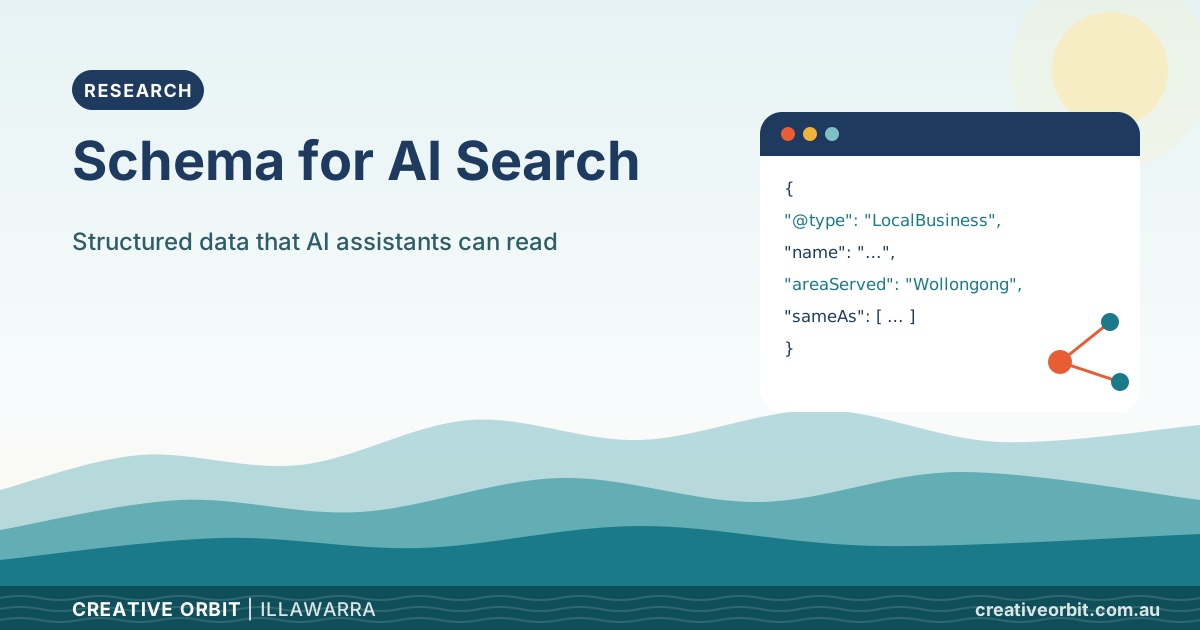
The schema for AI search should describe visible content accurately; it is not a special code that...
Social Media in Australia
Social media remains a major Australian communications, discovery and news channel, but no single...