Agentic Optimisation (AO)
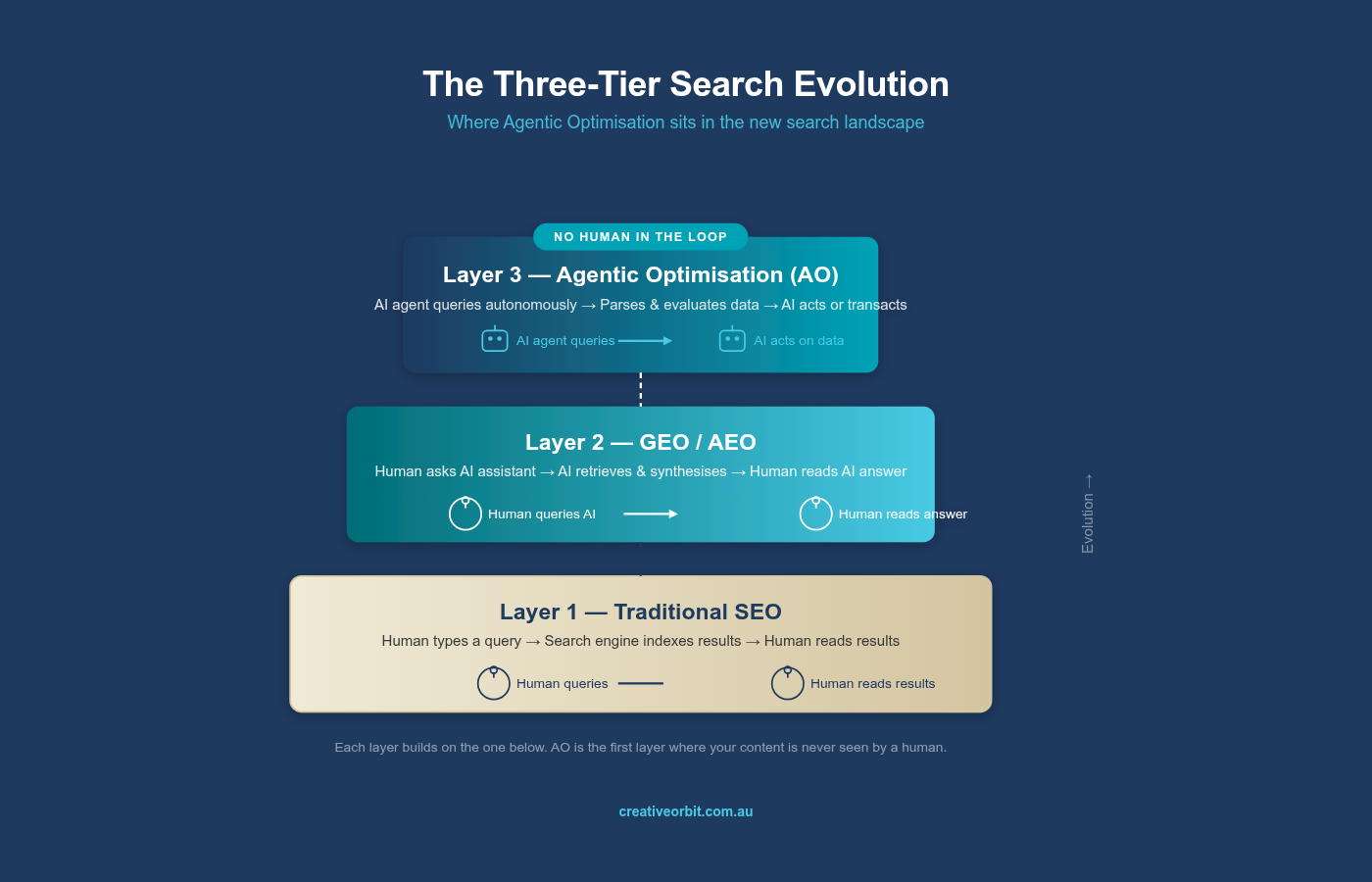
Agentic Optimisation (AO) is the next layer of search — and most Australian businesses don't know it...

Why a #3 Google ranking gets zero clicks in AI search → Read the AI SEO Paradox
The search landscape has fundamentally changed. AI-powered search engines and the dramatic evolution of SERPs are reshaping how businesses are discovered. This comprehensive guide shows Wollongong and Illawarra businesses how to thrive in the answer engine era by mastering intent optimisation, zero-click features, and multi-experience strategy.
Understanding how we got here helps predict where search is going. The SERP (Search Engine Results Page) has evolved through three distinct eras, each fundamentally changing how businesses compete for visibility.
The original search experience was simple: type a query, get ten blue links ranked by PageRank. Success meant ranking #1 for your target keywords.
RankBrain (2015) and BERT (2019) introduced machine learning and natural language understanding. Google began interpreting intent rather than just matching keywords.
Generative AI (Google's AI Overviews, SGE) transforms search into an answer engine. Up to 60% of searches now end without clicking on any website.
The modern SERP is no longer a simple list. It's a complex, dynamic interface designed to answer queries without requiring clicks. Understanding each feature and how to optimise for it is essential for visibility.
Google's generative AI generates instant summaries at the top of search results, now appearing in nearly half of all queries and up to 75% of the mobile screen.
Quick answer boxes are still crucial for authority, although often replaced or supplemented by AI-generated summaries.
Direct facts from trusted sources and brands - builds instant credibility for Wollongong regional businesses.
YouTube and video content now dominate visual search queries, especially for service industries and how-tos.
Expandable questions connect users to multiple related answers without leaving Google.
Map-based results essential for regional services, with reviews and contact info front and centre.
Google now ranks pages based on user satisfaction, not just clicks or keywords. Traditional metrics like meta tags and backlinks matter less - what's crucial is whether your content solves user problems and completes their journey.
Intent Satisfaction Metrics (ISM) measure whether content actually fulfils the user's search intent. Google tracks post-click behaviour to determine if users found what they needed or had to search again.
Did the user need additional searches? If they return to search results immediately, the content failed to satisfy the intent.
Did they engage with content? Quick bounces signal poor intent, a match, or low quality.
Did they scroll, click internal links, or take action? Deep engagement signals satisfaction.
Did they stop searching after finding your content? The ultimate success metric.
Over 60% of mobile searches end without a user clicking on any website
Nearly half of queries now show AI-generated summaries
Organic click-through rates plummet when AI Overviews appear
Demonstrating community-specific expertise and providing complete answers are now key to visibility. Generic content loses to locally-relevant, comprehensive solutions.
Success in 2026 requires a unified approach across three interconnected optimisation disciplines. Traditional SEO alone is no longer sufficient.
Optimise content for Google's organic listings - still vital, but just one piece of the puzzle.
Even with zero-click dominance, organic listings remain important for:
Build content that works across platforms: Google, Bing, voice, video, and AI engines. Cross-platform authority is crucial as users match tools to their intent.
Users now search across multiple platforms based on intent:
Being visible only on Google means missing 40%+ of search behaviour.
Design content for featured snippets, direct answers, and voice search - become the definitive solution to user queries.
With 60% zero-click searches, being the cited answer matters more than click-through:
Don't optimise for one channel in isolation. Create comprehensive, authoritative content that serves users across all experiences:
Result: Visible across Google organic, local pack, YouTube, featured snippets, AI Overviews, and voice assistants. Comprehensive visibility beats single-channel optimisation.
Practical strategies to thrive in the AI search era, specifically tailored for regional businesses competing in both local and national markets.
Focus on providing comprehensive, locally relevant solutions to become the primary reference for AI engines.
Use clear headings, concise answers, and rich schema to maximise citation in AI Overviews.
Invest in video, images, and infographics - visual results are driving search behaviour.
Ensure consistency across Google, Facebook, Wikipedia, and local directories to feed the Knowledge Graph.
Track completion rates, user satisfaction, and feedback - not just traffic or old SEO metrics.
Maintain a strong NAP presence and detailed regional stories to support local pack and zero-click prominence.
The search landscape continues evolving rapidly. Stay ahead by understanding and preparing for emerging trends that will shape search in 2026 and beyond.
Voice and chat are rising - optimise for natural questions and multi-step intent.
AI increasingly tailors results to context, device, location, and user profile.
Images and video answers are replacing traditional text, especially for services and local enquiries.
Ensure branded content is present where users are searching - not just Google.
The traditional SERP was ten blue links ranked by PageRank — success meant ranking #1 for a target keyword. The new SERP is dominated by AI Overviews, featured snippets, knowledge panels, local packs, and video carousels that answer queries directly on the results page. AI Overviews now appear in 47% of Google searches, occupy up to 75% of mobile screens, and push organic results down by 1,500 pixels. The practical consequence: organic click-through rates drop from 2.94% to 0.846% when an AI Overview appears. Ranking #1 no longer guarantees traffic; being the cited source inside the AI answer does.
Zero-click means the user gets their answer directly from the SERP — from an AI Overview, featured snippet, or knowledge panel — without visiting any website. Up to 60% of Google searches now end this way. For Wollongong businesses, this changes the goal of SEO: instead of ranking for clicks, you need to be the source Google's AI cites in its answer. A business that is cited in an AI Overview is visible to that user even though no click occurred — and that brand impression influences the next search, the direct visit, and the eventual purchase decision.
SEO (Search Engine Optimisation) targets ranking in Google's traditional organic results — service pages, blog content, backlinks, technical health. MEO (Multi-Experience Optimisation) extends visibility across every platform where your customers search: YouTube, TikTok, Instagram, Google Maps, Pinterest, and AI chatbots — because being visible only on Google means missing 40%+ of search behaviour. AEO (Answer Engine Optimisation) targets being the cited source inside AI-generated answers on ChatGPT, Perplexity, Google AI Overviews, and voice assistants. All three are now required for full visibility — a Wollongong business ranking well in SEO but absent from AEO and MEO is invisible to a growing share of its potential customers.
Intent Satisfaction Metrics (ISM) are the signals Google tracks to determine whether a page actually satisfied the user's query — scroll depth, time on page, interactions, bounce rate, and whether the user returned to Google to search again. In 2026 these signals are a direct ranking factor, not a secondary consideration. For Illawarra businesses, this means content that answers questions completely — with local specificity, structured headings, and direct answers — outperforms thinner content even with stronger backlinks, because Google can measure whether users found what they needed.
Four compounding actions: structure content with clear headings, lists, and tables so AI can extract and reformat it; answer target questions in 40–60 words directly below the relevant heading (the format AI Overview extraction favours); implement FAQ schema markup so Google can identify your Q&A content programmatically; and build topical authority through depth — a comprehensive local resource on a specific topic consistently beats a thin page targeting the same keyword. Local specificity matters: answers that include Wollongong, Illawarra, or suburb-level context are more likely to surface in localised AI Overviews than generic national content.
More important than ever. Local packs and Google Maps results are one of the few SERP surfaces where zero-click dominance is weaker — users clicking a local pack listing are high-intent and close to purchase. A complete, actively maintained Google Business Profile with consistent NAP (Name, Address, Phone) across all directories, genuine reviews that mention specific locations and services, and regular posts feeds directly into local pack rankings, knowledge panel accuracy, and AI Overview local citations. For Wollongong and Illawarra businesses, it remains the single highest-ROI optimisation action available.
Four trends are already reshaping search behaviour: conversational interfaces — voice searches via smart speakers and AI chatbots replacing single-query search sessions with multi-turn conversations; hyper-personalisation — results increasingly tailored by location, device, search history, and time of day, making local specificity more valuable not less; visual-first search — images, video carousels, and multimodal AI pushing text results further down every SERP; and cross-platform fragmentation — Gen Z using TikTok and Instagram as search engines, AI chatbots as primary research tools, and platform-specific search behaviours emerging that require presence beyond Google. Strategies that worked in 2023 consistently fail in 2026 for businesses that haven't adapted to these shifts.
Through an audit-first process that identifies exactly where your current visibility gaps are across SEO, MEO, and AEO — not a generic template applied to every client. A free Screaming Frog technical crawl establishes your technical baseline; Google Search Console and GA4 data maps your current search behaviour; and a competitive landscape analysis shows what's working in your specific suburb and industry. The output is a prioritised action plan built around your actual data. Simon Bayliss implements every element directly — no account managers, no offshore team, no lock-in contracts. Contact:
The search landscape has fundamentally changed. Strategies that worked in 2023 fail in 2026. I help Wollongong and Illawarra businesses adapt to AI search, zero-click SERPs, and multi-platform visibility requirements - with proven local expertise and measurable results.
Servicing: Wollongong, Shellharbour, Kiama, Dapto, Southern Highlands, and broader Illawarra/NSW South Coast. Remote consulting available for Australian businesses nationwide.
Local expertise. AI search specialists. Future-proof strategies. I stay current with Google's algorithm changes, SERP evolution, and emerging search behaviours to keep your business visible as search continues to transform.
Agentic Optimisation (AO) is the next layer of search — and most Australian businesses don't know it...

Product discovery has fundamentally shifted. When a customer researches a purchase—whether...
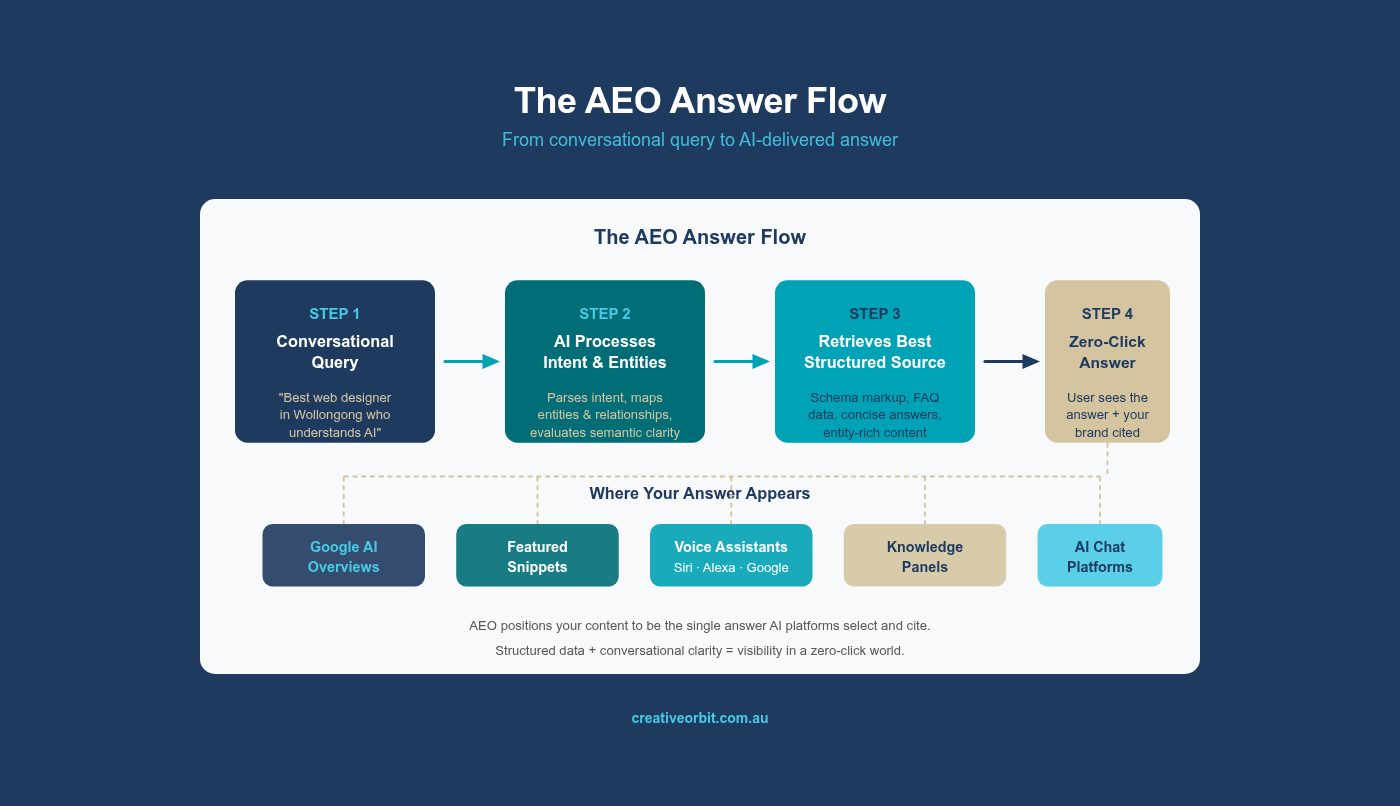
Your customers aren't typing two-word queries into Google anymore. They're asking their phone for...
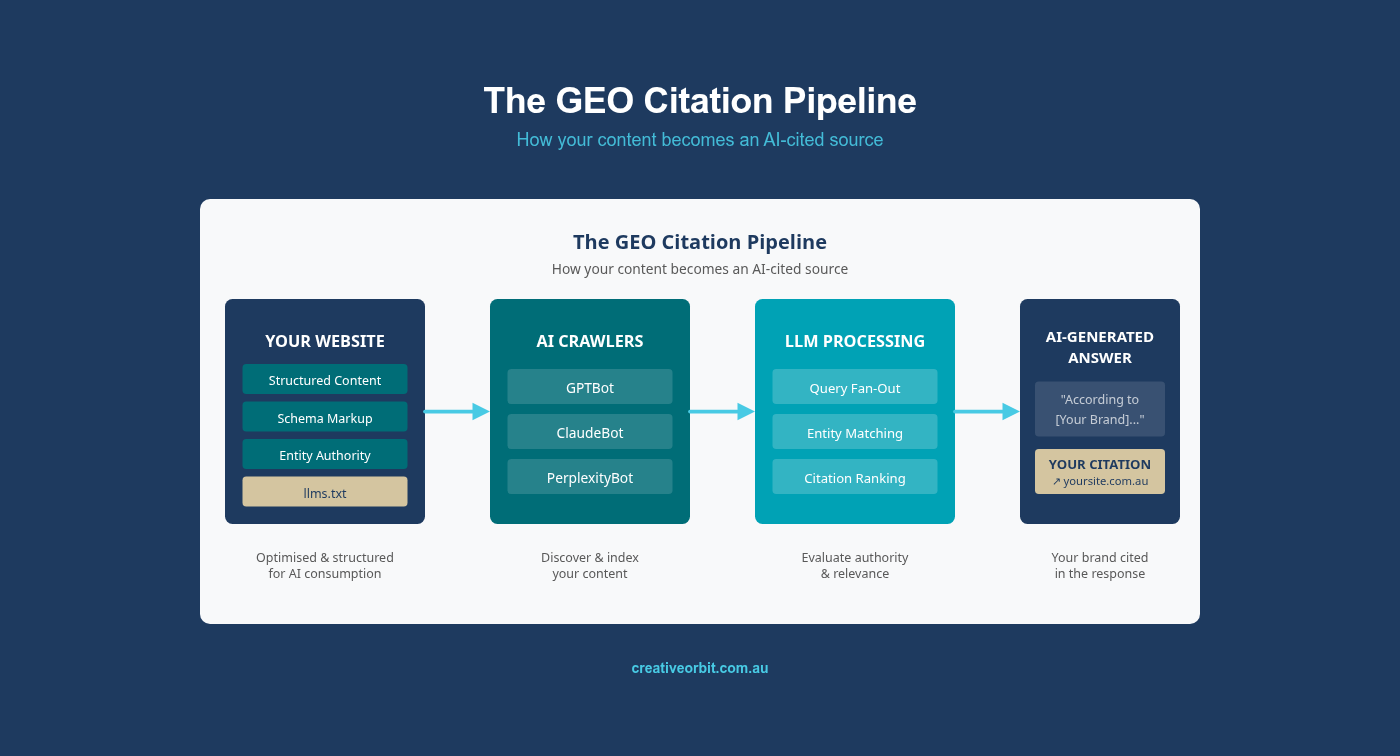
Having worked with regional businesses for over fifteen years, I've watched the search landscape shift...
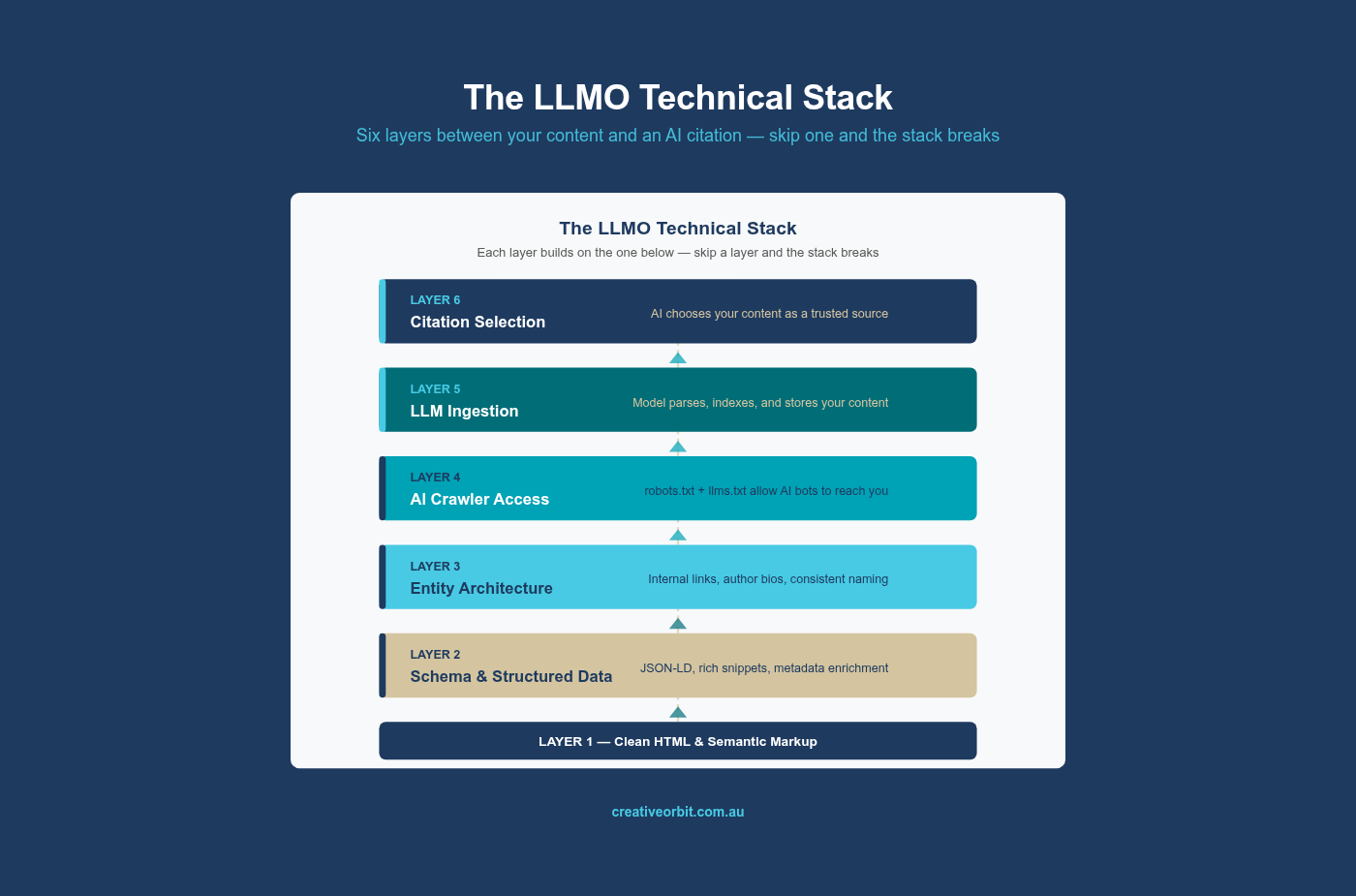
Large Language Model Optimisation (LLMO) is the technical foundation that determines whether AI...
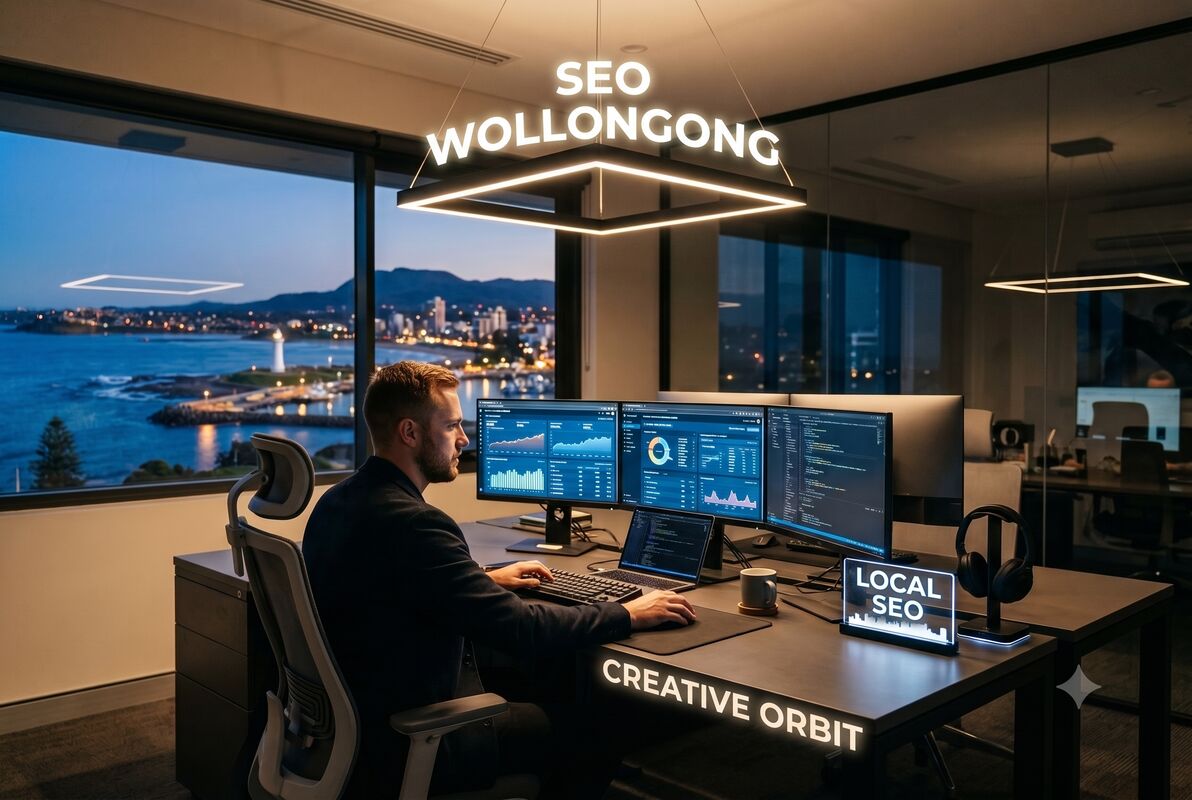
Local search in Wollongong has evolved. Earning dominant visibility across the Illawarra requires...
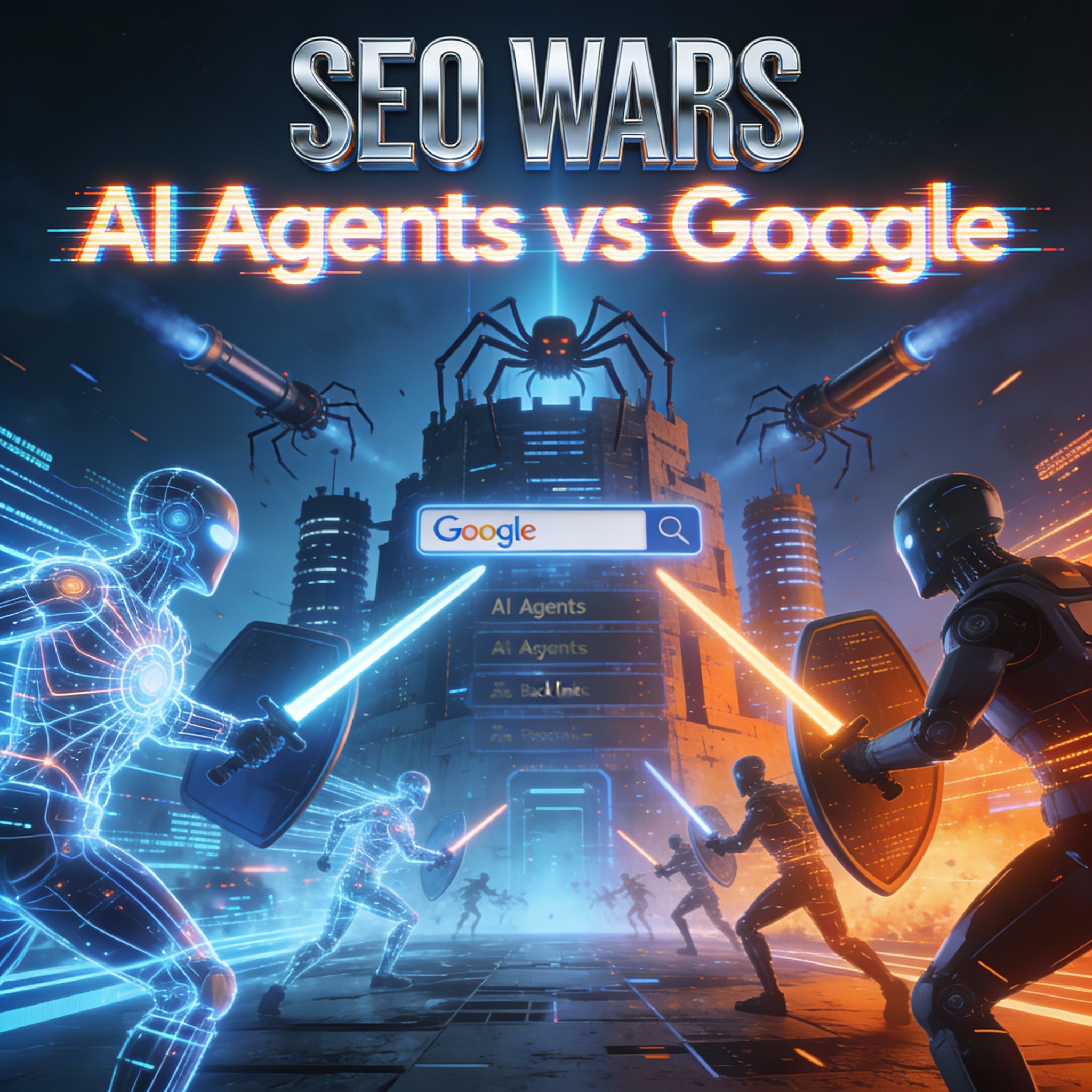
Traditional search was beautifully simple: type keywords, scan ten blue links, click through to...

Google's September 2025 algorithm update made local search more dynamic than ever, with search...

As Australia's photography services market is projected to reach $28.7 billion by 2033 and...

Google has no percentage limit for AI-generated content. In 2026, rankings are determined by...

In September 2025, Google unleashed its most transformative algorithm update yet — splitting...
By late 2025, AI Overviews were appearing in 13% to 47% of Google searches globally, and an...
Here's a question I've been asked at least a dozen times over the past six months: "Can AI write my...
Here's the reality: Google's AI Overviews haven't broken search - they've changed who wins. Some...

The digital landscape in 2025 is defined by disruption, integration, and rapidly-changing...
Creative Orbit is a Wollongong-based digital
...